Indoor air quality is shaped by dozens of small choices that add up over time: ventilation habits, cleaning products, cooking methods, humidity control, and yes—anything that burns indoors. Soy candles are often marketed as a “cleaner” option, but indoor air quality isn’t a vibe; it’s chemistry, combustion, and context. The good news is you don’t need a laboratory to make smarter choices. You just need to understand what actually changes the air in a room and which candle details matter the most.
This guide focuses on practical, high-impact factors—wax type, wick choice, fragrance load, burn behavior, and room conditions—so you can enjoy candles while being intentional about the air you breathe.
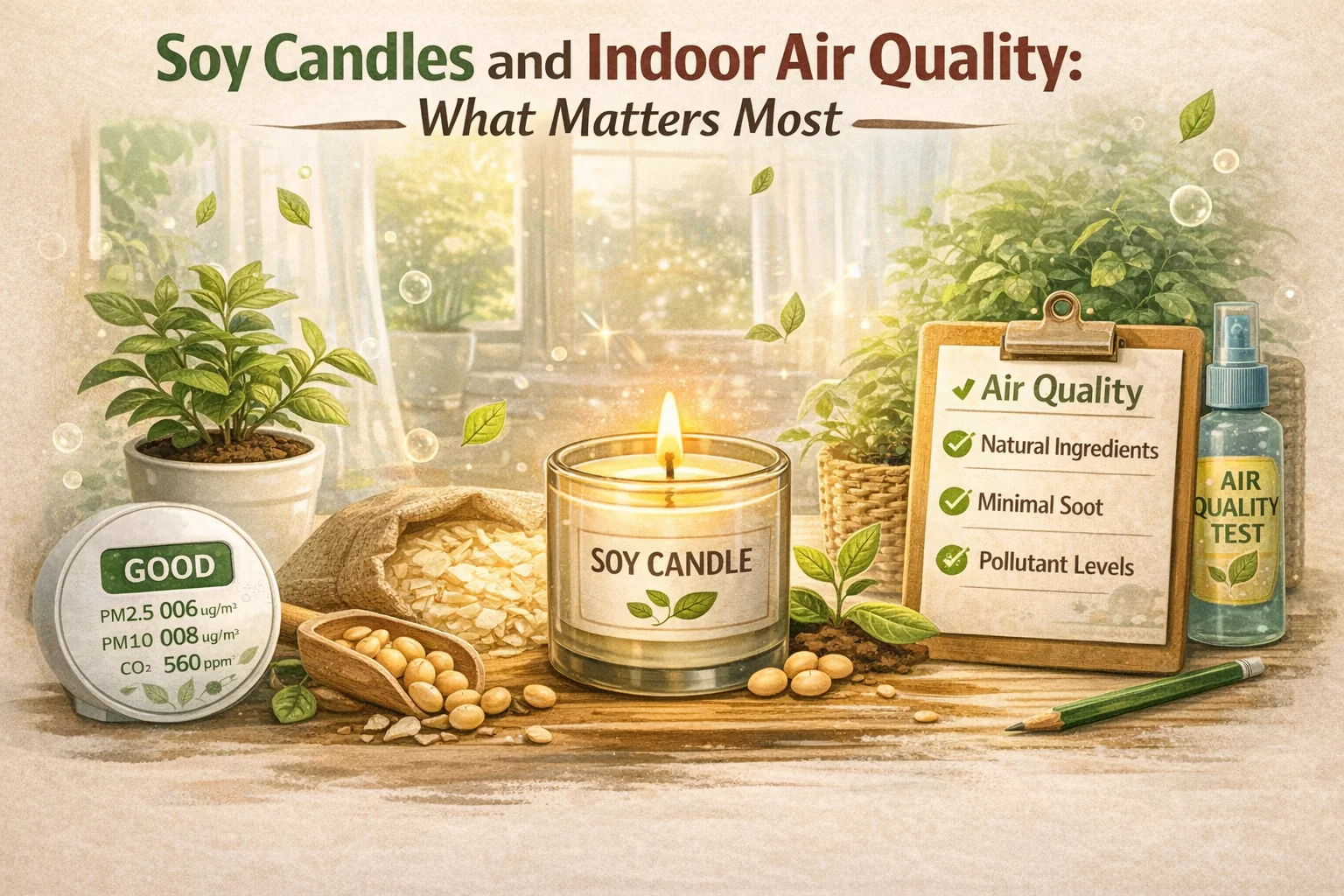
Indoor Air Quality and “Burning Something” in Plain Terms
Any flame indoors changes air composition. Combustion produces gases and tiny particles. In an ideal world, a candle would burn with complete combustion and produce mostly carbon dioxide and water vapor. In real rooms, combustion is not always perfect. Incomplete combustion can increase soot (fine particulate matter) and byproducts that are more noticeable in a closed space. Indoor air quality becomes a question of quantity and conditions: how much is released, how long it lingers, and how quickly your home exchanges indoor air with outdoor air.
If you’ve ever walked into a room and immediately smelled yesterday’s cooking or a lingering “smoky” candle note, you’ve experienced how indoor air acts like a storage system. Materials absorb odors; soft surfaces hold onto them; and without ventilation, the room slowly accumulates what you introduce.
What Soy Wax Can Improve—and What It Can’t
Soy wax is a vegetable-based wax, and that origin influences how it melts, how it holds fragrance, and how it typically behaves in a container candle. Many people choose soy because it often burns at a lower temperature than some other wax types and is widely perceived as a more “natural” option. But here’s the key point for indoor air quality: the wax alone doesn’t determine what ends up in the air. The wick, the fragrance (or essential oils), the dye load, and the burn behavior can matter just as much—sometimes more.
Think of wax as the fuel base. Even a high-quality fuel can burn poorly if the “engine” is mis-tuned. A wick that’s too large, a candle that tunnels, or a flame that flickers aggressively can increase soot and smoke regardless of whether the wax is soy, beeswax, paraffin, or a blend.
The Biggest Air-Quality Factors When Using Soy Candles
If you only remember one thing, remember this: indoor air impact is mostly driven by how cleanly the candle burns in your specific space. These are the variables that most directly influence that outcome.
Wick type and wick sizing
Wick choice is an air-quality decision. A well-sized wick supports a steady flame that consumes vaporized wax efficiently. An oversized wick can create an overly large flame, higher temperatures, and more visible smoke—especially when you blow it out. An undersized wick can lead to tunneling, which often causes repeated relighting, longer burn times to “fix” the melt pool, and inconsistent combustion.
Cotton and wood wicks can both perform well when correctly matched to the jar diameter, wax blend, and fragrance load. The practical indicator is not the marketing label; it’s the behavior: a calm, teardrop-shaped flame, minimal flicker, and little to no visible smoke during normal burning.
Fragrance load and what’s doing the scenting
Scent is often the dominant variable for perception and comfort. A candle’s aroma comes from volatile compounds that are designed to evaporate into your room air. More fragrance oil generally means a stronger throw, but it can also stress the burn if the formulation isn’t balanced—leading to soot or a “chemical” note that lingers.
For indoor air quality, moderation matters. If you notice throat scratchiness, headaches, or a heavy lingering smell, the most effective change is to choose lighter fragrances, burn for shorter periods, or use the candle in a larger, better-ventilated room. Unscented soy candles (or very lightly scented ones) typically introduce fewer scent compounds into the air, which can be a meaningful difference for sensitive households.
Soot formation and visible smoke
Soot is the most obvious indoor air quality red flag with candles. If you see black residue inside the jar, dark marks on walls, or smoke trails when the candle is burning, combustion is incomplete. That usually points to one of these: a wick that needs trimming, a drafty location causing the flame to dance, a wick that’s too large, or a candle that’s burning too long in one session.
A clean burn should be boring. Minimal flicker, minimal smoke, minimal residue. The less drama, the better the air.
Ventilation and room size
Ventilation is the quiet hero of indoor air quality. A candle in a small bathroom with a closed door behaves very differently from the same candle in a living room with airflow. If you want to reduce impact without giving up candles, prioritize fresh air exchange. Even a small amount of ventilation can reduce how long fragrance and combustion byproducts linger.
If opening windows isn’t practical, consider running an exhaust fan nearby, using the candle for shorter durations, or limiting candle use to larger rooms. Indoor air quality isn’t only what’s released—it’s also how quickly your home dilutes and removes it.
Best Practices for a Cleaner Burn With Soy Candles
The safest, highest-impact habits are surprisingly simple. They focus on keeping combustion stable and reducing soot opportunities.
Trim the wick consistently
A too-long wick is one of the most common causes of smoke and soot. Trimming helps control flame height and supports steadier combustion. Aim for a short, neat wick before lighting, and remove any mushrooming (the dark carbon cap that can form at the wick tip).
Avoid drafts and “flicker zones”
Drafts cause irregular combustion. Place candles away from open windows, fans, high-traffic walkways, and vents. A dancing flame is visually cozy, but it’s usually less efficient and more likely to produce soot. Stability matters.
Burn for sensible sessions
Very long burns can overheat the wax pool and increase smoke when extinguishing. Very short burns can encourage tunneling, which leads to repeated relights and uneven burning. A balanced approach is to let the candle form a consistent melt pool across the top early in its life, then use reasonable session lengths for your space.
Extinguish without smoke when possible
Many of the biggest smoke bursts happen at the end. Blowing out can create a visible plume. If you want to reduce that, use a snuffer or gently dip the wick into the melt pool and straighten it again (only if it can be done safely and cleanly). A low-smoke extinguish reduces that last-minute “burnt” note that can linger in closed rooms.
Scent Sensitivity, Allergies, and “Clean Air” Expectations
Indoor air quality is partly objective (particles and gases) and partly personal (how your body reacts to smells). Some people are highly sensitive to fragrance compounds even at low levels. If someone in the home experiences frequent irritation, the “best” candle is often simply an unscented candle or a very lightly scented one used occasionally with ventilation.
It also helps to separate two ideas that are often blended together in advertising. “Natural” doesn’t automatically mean “non-irritating.” Essential oils, for example, are natural extracts but can still be potent in the air and may trigger sensitivity. For air comfort, the gentlest option is usually less scent, not a different kind of scent.
How to Choose a Soy Candle With Air Quality in Mind
Shopping for a candle can feel like decoding labels. Instead of chasing buzzwords, look for practical indicators of a careful formulation and a stable burn.
Consider choosing candles that clearly describe their materials and prioritize simplicity. Unscented or lightly scented options are a strong baseline for air-conscious homes. Candles that burn cleanly tend to have predictable behavior: steady flame, low residue, and minimal smoke during extinguishing.
If you can, start with one candle and “test” it in your home the way you would test a new cleaning product. Burn it in a larger room for a short session, pay attention to residue, and notice how the air feels afterward. Your space and ventilation habits matter as much as the candle itself.
The Role of Everyday Indoor Sources: Don’t Blame the Candle for Everything
One reason candle discussions get confusing is that candles are only one contributor to indoor air quality. Cooking, frying, toasting, incense, fireplaces, aerosol sprays, and even dusty HVAC filters can have a larger impact than an occasional candle. If indoor air feels heavy, the fastest improvements often come from ventilation routines, replacing filters on time, controlling humidity, and reducing strong aerosols—not only from switching wax types.
If you love candles, focus on the highest-leverage changes: burn less frequently, choose lighter scents, keep wicks trimmed, avoid drafts, and ventilate the room. These steps reduce the chance of soot and help the air reset quickly.
A Practical “Clean Burn” Checklist for Your Home
A candle that supports better indoor air habits is one that behaves consistently and doesn’t leave evidence behind. Use this mental checklist during the first few burns:
The flame is steady and not aggressively flickering. The wick stays short and doesn’t create a large mushroom cap. The glass stays relatively clean without heavy black residue. The candle doesn’t smoke during normal burning. When you extinguish it, smoke is minimal and the lingering “burnt” note fades quickly with light ventilation.
If a candle repeatedly fails these checks, it’s not a personal failure and it’s not your room being “too picky.” It’s simply a sign that the wick, wax blend, and fragrance load aren’t working well together in that container.
Conclusion: What Matters Most, Summed Up Simply
Soy candles can be a good choice for many homes, but indoor air quality depends less on the word “soy” and more on the total burn system: wick sizing, fragrance intensity, combustion stability, and ventilation. If you want the best outcome, choose candles that burn steadily, keep the wick trimmed, avoid drafts, and let fresh air exchange do its job. A calmer flame and a lighter scent usually mean a lighter footprint in your indoor air.
The goal isn’t to make your home scent-free. The goal is to make your air feel clean, comfortable, and easy to breathe while still enjoying the warmth and ritual that candles bring.