Wax choices have evolved far beyond the old “one-size-fits-all” candle aisle. Today, soy wax and rapeseed wax sit at the center of the modern candle conversation, especially for shoppers who want a cleaner burn, a smoother look, and a material story that feels more responsible. Both are plant-based. Both can produce beautiful results. And both come with trade-offs that matter, depending on what you value most: scent performance, jar appearance, burn behavior, sourcing, or the “feel” of the candle as a finished product.
This comparison breaks down what’s truly different between soy and rapeseed wax candles in practical terms. You’ll see how they behave in real homes, how they tend to look and smell, and what to ask before buying—without hype, fear, or marketing buzzwords.
What Each Wax Actually Is
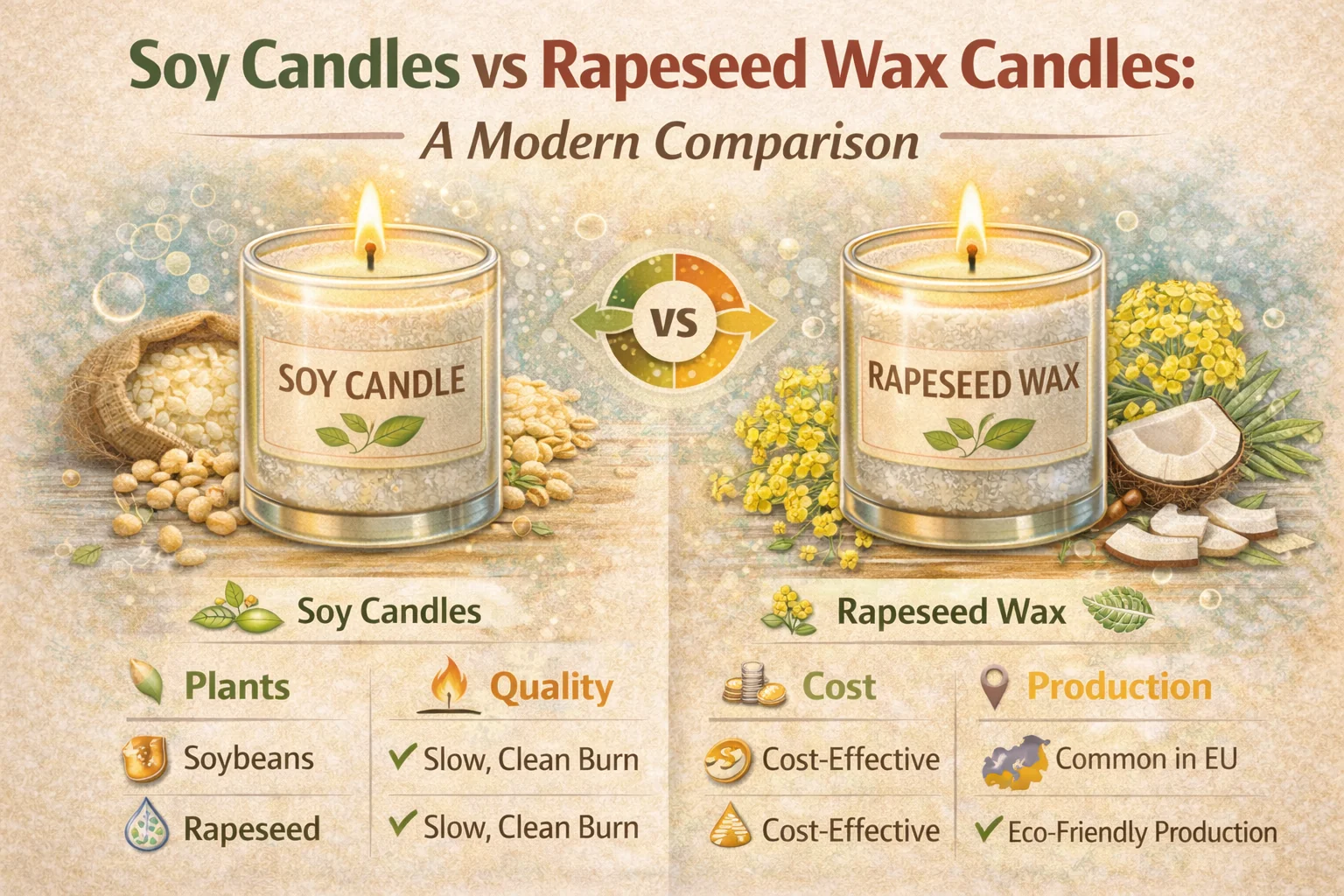
Soy wax is made from soybean oil that’s been processed into a solid wax. It became popular because it’s plant-based, typically burns slower than many traditional waxes, and is widely available. You’ll find soy candles everywhere—from big retail brands to small makers—because the supply chain is large and standardized.
Rapeseed wax is made from rapeseed oil (often associated with canola). In candle form, it’s especially common in parts of Europe, where rapeseed is widely grown. It’s also plant-based, and it has gained attention for its smooth finish, reliable scent throw, and the possibility of more regional sourcing in certain markets.
The Big Picture: Similar Goals, Different Personalities
If soy wax and rapeseed wax were people, soy would be the mainstream overachiever: flexible, widely understood, and easy to find—sometimes inconsistent depending on the formula. Rapeseed would be the modern minimalist: smooth, tidy, and quietly impressive—sometimes harder to source and not as familiar to everyone.
Neither is automatically “better.” The best choice depends on the quality of the candle, the wick, the fragrance load, and how the maker built the formula. A well-made soy candle can outperform a poorly made rapeseed candle, and vice versa. Wax is only one part of a bigger system.
Burn Time and Heat: What You’ll Notice at Home
Many people choose plant wax because they want a longer, calmer burn. Soy is often praised for burn time, especially in container candles, because it generally melts at a relatively low temperature and can burn slowly when matched with the right wick. That said, soy candles can be picky. If the wick is undersized, you might see “tunneling,” where the candle melts only in a small circle down the middle. If the wick is oversized, the flame can burn too hot and shorten the life of the candle.
Rapeseed wax also tends to burn smoothly at a moderate temperature. Many rapeseed wax candles feel steady and “even” in their melt behavior, especially in well-designed jars. Rapeseed can be more forgiving in appearance during the burn, but it’s still sensitive to wick choice and jar size like any wax. In real use, both can offer good longevity—what matters most is whether the candle reaches an even melt pool within a reasonable time without overheating.
Scent Throw: Cold Throw vs Hot Throw
When people talk about scent performance, they’re usually describing two experiences. Cold throw is how the candle smells when it’s not lit—like when you take the lid off or walk past it. Hot throw is how the fragrance fills the room while it’s burning.
Soy wax can produce a lovely hot throw, especially in medium-to-small rooms. Some fragrance types perform exceptionally well in soy, while others may feel softer or take longer to develop in the air. A lot depends on the fragrance blend, the cure time (how long the candle rests before being used), and the wick’s ability to create a stable melt pool.
Rapeseed wax is often described as having strong fragrance potential and good scent clarity. Many users notice a clean, bright aroma profile that doesn’t feel “muted.” This can make rapeseed candles feel more immediate in open spaces. Still, results vary by maker—there’s no magic wax that guarantees a room-filling scent if the candle is under-wicked or rushed to market before it has properly cured.
Appearance: Frosting, Smoothness, and That “Luxury” Look
If you’ve ever seen a soy candle develop a cloudy, crystalline pattern on top, you’ve seen soy frosting. Frosting is common in many soy formulas. It’s not mold, and it doesn’t automatically mean the candle is low quality. It’s simply a natural visual characteristic of some soy wax blends as they cool and re-crystallize over time.
For some people, frosting is part of the handmade charm. For others—especially shoppers who want that perfectly smooth, high-end finish—it can feel like a flaw. Makers often reduce frosting with specific soy blends, temperature control, additives, and careful pouring techniques, but it can still appear.
Rapeseed wax frequently delivers a very smooth, uniform surface in containers, which is one reason it’s associated with a modern “clean aesthetic.” It can cool with a tidy look and may be less prone to dramatic frosting patterns. That said, any wax can show surface changes depending on room temperature swings, shipping conditions, and time.
Soot and Smoke: What’s Realistic to Expect
A common promise in candle marketing is “no soot” or “smoke-free.” In reality, any candle can produce soot if the flame is too large, the wick mushrooms, the candle burns in a draft, or the jar design pushes the flame into an inefficient burn. Wax choice matters, but wick quality and user habits matter just as much.
Both soy and rapeseed wax are generally associated with cleaner-burning performance compared with many older-style candles. However, “cleaner” does not mean “perfect.” If you want to minimize soot, focus on practical factors: trim the wick, avoid drafts, don’t burn for excessively long sessions, and use a candle that is properly wicked for its jar size.
Sustainability and Sourcing: The Questions That Matter
Both soy and rapeseed wax are plant-based, but sustainability is bigger than the word “natural.” It includes how crops are grown, how land is used, whether the supply chain is traceable, how far materials travel, and what processing is involved.
Soy wax is often produced at very large scale, which can be a strength (consistent availability) and a challenge (complex global supply chains). Some shoppers prefer soy when it’s sourced from transparent, responsible producers. Others prefer to avoid it if they’re concerned about industrial farming practices in general.
Rapeseed wax can appeal to buyers who like the idea of more regional sourcing—especially in areas where rapeseed is widely grown. That doesn’t guarantee sustainability by itself, but it can shorten transport distances depending on where you live and where the wax was produced. If sourcing matters to you, the most useful question isn’t “is it soy or rapeseed?” but “where is it sourced, and can the brand explain the supply chain without dodging?”
Allergies, Sensitivities, and Indoor Comfort
Many people shop for plant-based candles because they want a gentler indoor experience. But sensitivity is usually more about fragrance ingredients, wick materials, and how strong the candle is than the wax alone. A heavily fragranced soy candle can feel overwhelming, while a lightly fragranced rapeseed candle may feel easy to live with—or the opposite—depending on the formula.
If you’re fragrance-sensitive, look for brands that are transparent about scent strength, and consider choosing candles with simpler fragrance profiles. Another approach is to use smaller candles in smaller rooms, rather than overpowering a space with an extra-strong candle that’s harder to control.
Performance in Different Candle Styles
Most shoppers buy container candles, and both waxes can excel in jars. But wax choice can also influence how a candle behaves in different formats.
In container candles, soy is extremely common and can deliver great burn time and pleasing scent diffusion when properly wicked and cured. Rapeseed wax can also perform exceptionally well in containers, often with a very refined surface appearance.
In pillars and freestanding shapes, wax hardness and stability become more important. Some soy formulas are softer and may require blending to perform well as pillars. Rapeseed wax is also often formulated or blended for specific use cases. If you’re buying a pillar candle, pay extra attention to whether the wax is designed for freestanding performance, not just described as “plant-based.”
Wicks, Additives, and Blends: The Hidden Variables
Two candles can both claim to be “soy” and behave completely differently. The same is true for rapeseed. Many candles use blends—sometimes soy with a small amount of another plant wax, sometimes rapeseed with other waxes to increase stability or change scent throw. Additives may be used to improve appearance, reduce frosting, adjust burn temperature, or help fragrance bind evenly.
This is why brand quality matters so much. The best candles aren’t just made from a trendy wax—they’re tested. A responsible maker chooses the right wick series, sizes it to the jar, and tests burn sessions long enough to confirm safe performance and consistent scent output.
How to Choose Between Soy and Rapeseed as a Buyer
If you want a candle that’s easy to find, available in nearly every scent category, and backed by lots of reviews and options, soy is usually the simplest path. You can find everything from subtle spa scents to bold bakery fragrances in soy formulas, and the market is mature enough that you can compare brands quickly.
If you want a modern luxury feel—especially a smooth, clean look in the jar—and you like exploring newer wax options, rapeseed wax candles can be a rewarding choice. Many people who switch to rapeseed describe it as feeling “sleeker,” with fragrance that feels clear and a burn that feels steady. Availability may be more limited depending on your region, but that scarcity sometimes goes hand in hand with small-batch craftsmanship.
What to Look For on the Label and Product Page
Regardless of wax type, a few details are strong signs you’re buying a thoughtfully made candle. Look for a clear burn time estimate, a wick type that sounds intentional (not vague), and sizing that matches the jar. Brands that provide care instructions usually care about performance and safety.
If a candle claims “non-toxic” without any explanation, treat it as marketing rather than a meaningful standard. Better signs are transparency: what wax is used, whether it’s a blend, how strong the scent is intended to be, and what kind of wick is inside. Even without technical details, the presence of consistent guidance is usually a good signal.
Simple Care Tips That Make Either Wax Perform Better
The easiest way to love a candle longer is to burn it with intention. Let the candle melt across most of the surface during the first burn so it “sets” an even pattern. Keep the wick trimmed to a reasonable length, and don’t place the candle in a windy spot where the flame struggles. Use a heat-resistant surface, and keep the melt pool free of debris. Small habits can dramatically change how cleanly and evenly a candle burns.
Final Thoughts: Which One Wins?
Soy and rapeseed wax candles both represent the modern shift toward plant-based materials and better overall candle experiences. Soy wins on availability and variety—you can find it almost anywhere, in nearly any scent, at nearly any price point. Rapeseed often wins on aesthetics and a sleek “modern” feel, and it can deliver excellent scent performance when produced with care.
The real winner, though, is a well-made candle: a stable wick, a tested jar size, a thoughtful fragrance level, and clear care instructions. If you choose a quality brand and burn the candle properly, both soy and rapeseed wax can create the same end result: a room that feels warmer, calmer, and more inviting—without unnecessary smoke, mess, or disappointment.