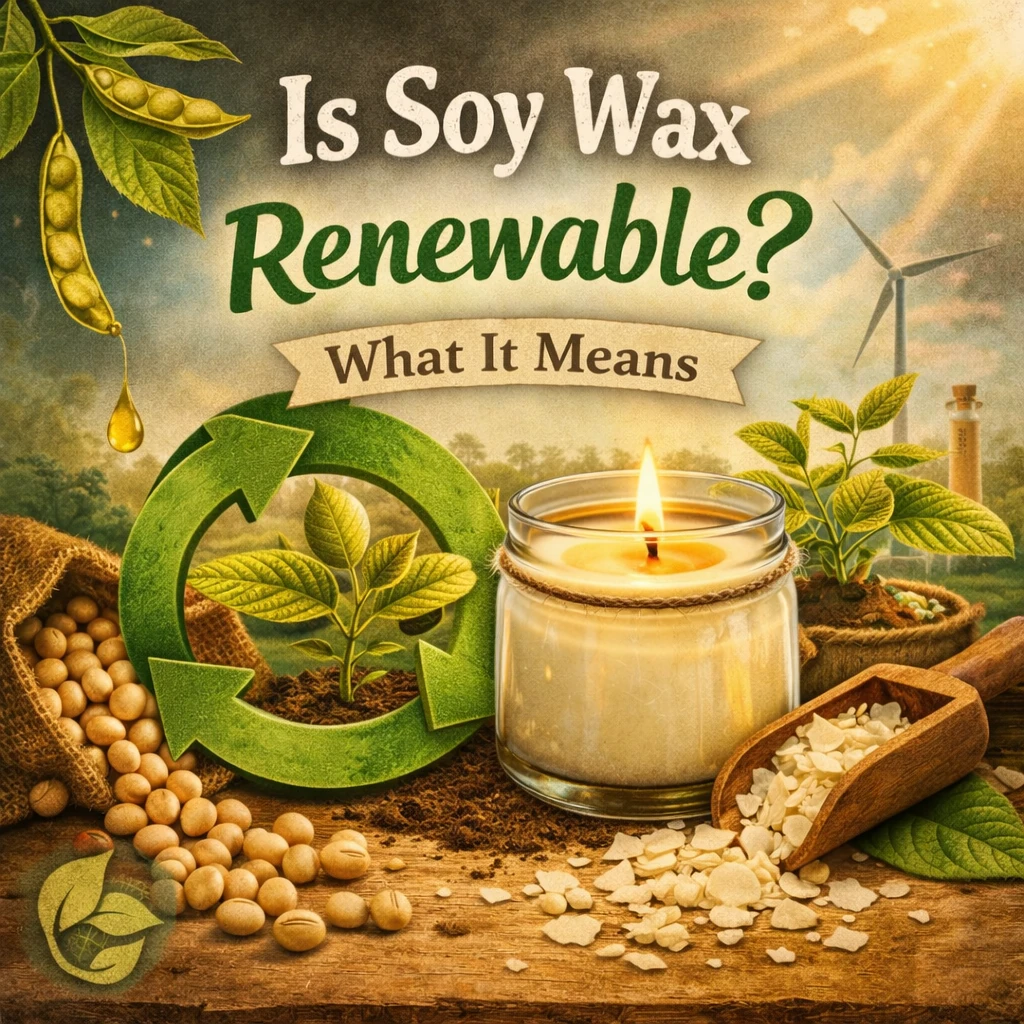
“Renewable” is one of those words that shows up everywhere in product descriptions, packaging, and shopping filters—especially in candles. Soy wax is often marketed as a renewable wax, but the real meaning is more specific than a simple yes-or-no label. If you’re choosing candles for your home, for a gift, or for a small business, understanding what “renewable” actually refers to can help you make decisions based on facts instead of buzzwords.
This article explains what it means for soy wax to be renewable, what it doesn’t mean, and what to look for if you care about sustainability, farming impacts, supply chains, and transparency. The goal is clarity: how soy wax is produced, why it is commonly called renewable, and where the trade-offs live.
What “Renewable” Means in Wax Terms
In everyday language, “renewable” usually means something can be replenished on a human timescale. In wax terms, it means the raw material comes from a source that can be grown or regrown relatively quickly, rather than extracted from a finite deposit. That’s why plant-based waxes (like soy) are often described as renewable, while petroleum-derived waxes (like paraffin) are not.
The key idea is the origin of the carbon and the feedstock: soy wax begins with soybeans, an agricultural crop that can be planted each season. Renewable does not automatically mean “low impact” or “perfectly sustainable,” and it doesn’t guarantee ethical farming practices. It simply points to a supply that can be replenished through cultivation.
How Soy Wax Is Made
Soy wax typically starts with soybean oil. Soybeans are harvested, processed, and pressed (or solvent-extracted) to produce oil. That oil is then refined, and in many cases hydrogenated to change its melting behavior and stability—turning a liquid oil into a more solid wax-like material that works in candle applications.
This matters because “renewable” is about the feedstock (soybeans), not about the simplicity of the processing. Soy wax production is not identical to “melt soybeans and you get wax.” It’s a manufacturing process that depends on industrial systems, energy use, transport, and (depending on the supplier) additional additives or blending. Understanding that helps keep expectations realistic.
So… Is Soy Wax Renewable?
In the plain meaning of the term, soy wax is widely considered renewable because it is derived from soybeans, which can be grown again and again. Compared to fossil-based waxes, the feedstock is not a one-time extraction from a finite underground reserve. If you think about supply in decades and centuries, crops can be replanted; petroleum reserves cannot be “regrown” once used.
But it’s important to separate “renewable feedstock” from “impact-free.” Farming requires land, water, fertilizer, machinery, and shipping. Depending on region and agricultural practices, soy cultivation can involve environmental concerns such as deforestation pressure, habitat loss, runoff, and intensive monoculture. A product can be renewable and still carry a meaningful footprint.
Renewable vs. Sustainable: Why the Difference Matters
“Renewable” describes the ability to replenish the source. “Sustainable” is broader: it asks whether the entire lifecycle—farming, processing, transportation, manufacturing, and end use—can be maintained long-term without unacceptable harm. A renewable input can be produced unsustainably if it relies on destructive land conversion or heavy pollution.
For shoppers, the difference shows up in the kinds of questions you ask. “Is it renewable?” is a starting point. “How was it farmed, processed, and transported?” is where sustainability becomes more concrete. This is why two soy wax candles can differ in environmental profile even if both use “soy wax.”
What Renewable Does NOT Guarantee
The renewable label can be helpful, but it can also be overused. Here are common assumptions that don’t automatically follow from “renewable” on a candle label:
Renewable does not guarantee that the soy was grown locally. Many supply chains are global, and transportation adds emissions. Renewable does not guarantee that the soy was grown without heavy chemical inputs. Farming methods vary widely. Renewable does not guarantee that the wax is free from additives or blends. Some “soy” waxes are mixed with other waxes to change performance. Renewable does not guarantee clean fragrance or low-smoke burning; those factors depend on wick selection, fragrance load, vessel design, and the overall formulation.
Land Use: The Big Question Behind Agricultural Waxes
When a wax comes from a crop, the most important environmental conversation usually shifts to land use. Land is finite, and agriculture must balance food demand, ecosystems, and industrial uses. Soy is used for many products, including animal feed and cooking oil, which means soy wax is part of a broader system rather than a standalone crop.
Some people prefer soy wax because it comes from plants rather than petroleum. That preference is valid, but it should be paired with curiosity about farming practices and sourcing. Soybeans grown on existing farmland with responsible practices are a different story than soybeans linked to land conversion and habitat loss. If a brand can explain where its soy is sourced and how it thinks about land impact, that’s usually a strong sign.
Processing and Energy: The Hidden Side of “Natural”
Soy wax is plant-based, but it’s still an industrial product. Turning soy oil into candle-ready wax requires processing steps, and those steps rely on energy. The carbon footprint of that energy depends on the local grid and the efficiency of the facility. “Natural” in the sense of “from a plant” doesn’t mean the wax arrives without manufacturing.
This doesn’t make soy wax “bad.” It just puts the renewable claim in the right place: it describes the source material, not the entire footprint. If you want to compare waxes fairly, you consider origin, processing, and transport together.
Blends, Additives, and Label Language
Candle labels can be confusing because “soy candle” may mean different things across different makers. Some candles use 100% soy wax. Others use soy blends that include other vegetable waxes or non-vegetable waxes to improve hot throw, glass adhesion, or burn stability. Blends are common in the industry because candles are performance products.
If “renewable” is one of your buying factors, it’s worth asking what “soy” means in the specific product. A straightforward approach is to look for clear wording such as “100% soy wax” or “soy blend,” and then ask what the blend contains. Transparent brands usually won’t treat this as a secret; they’ll explain it as part of formulation.
GMO and Organic: Common Questions People Ask
Many people connect renewable claims with questions about GMO crops or organic farming. Whether soy is GMO or non-GMO depends on the sourcing and region. Organic certification and non-GMO verification are separate standards. A renewable feedstock can be GMO; it can also be non-GMO. Likewise, it can be organic or conventional.
If those factors matter to you, look for specific certifications or direct statements from the maker. Be cautious with vague “clean” or “eco” terms that don’t say anything measurable. Better labels tell you what standard was used, what was verified, and who verified it.
What Renewable Means for Candle Performance
“Renewable” is not a performance spec, but soy wax does have performance characteristics that shape the candle experience. Many people choose soy candles because they tend to have a softer look, can burn steadily when properly wicked, and often work well for longer burn sessions when the candle is designed correctly. Like any wax, soy has trade-offs: it can be sensitive to temperature changes, and it may behave differently depending on fragrance type and vessel shape.
The important takeaway is that a renewable wax doesn’t automatically create a “better” candle. A well-made candle is a system: wax, fragrance, wick, jar, and curing time all interact. A renewable feedstock is a sourcing advantage, not a guarantee of perfect burn behavior.
How to Shop Smarter: Practical Signals of a Better Renewable Claim
If the renewable aspect is meaningful to you, look for brands that treat the claim as a doorway to more details rather than the final message. Good signs include clear descriptions of what wax is used, whether it is a blend, and why. Even better signs include sourcing statements, supplier transparency, and a willingness to talk about trade-offs honestly.
You can also look for practical sustainability behaviors that reflect intent: minimal packaging, recyclable materials, refill programs, responsibly sourced ingredients, and consistent product testing that reduces wasted batches. These are “real-world sustainability” indicators that often matter as much as the feedstock label.
A Clear, Honest Summary
Soy wax is commonly considered renewable because it is derived from soybeans—an agricultural crop that can be grown repeatedly. That renewable status is meaningful when compared to fossil-based waxes, because it shifts the source from a finite resource to a replenishable one. At the same time, “renewable” is not the same as “impact-free,” and it doesn’t automatically certify sustainable farming, low emissions, or clean supply chains.
If you care about what “renewable” really means, treat it as a first filter, not the final answer. The most informed choice comes from pairing the renewable label with transparency: where the soy comes from, how it was processed, what the candle contains beyond wax, and how the maker thinks about sustainability as a whole.