Candle choices look simple on the surface: pick a scent, pick a jar, light the wick. But the wax behind that warm glow has a real environmental footprint—from how the raw material is produced, to how the candle burns in your home, to what happens to the container and leftover wax afterward. The soy-versus-paraffin debate is often reduced to slogans, yet the environmental story is more nuanced. This article breaks down the comparison in a practical way, highlighting what is known, what is commonly misunderstood, and which factors matter most if you care about sustainability.
What “Environmental” Really Means for a Candle
“Eco-friendly” can mean many things depending on what you value. For candles, the environmental conversation usually falls into a few key buckets: the origin of the wax, the impacts of producing that wax, the emissions released while burning, and the waste created by packaging and end-of-life disposal. A candle can be renewable but still come with agricultural impacts; it can burn cleanly but be made from a high-impact supply chain; it can be beautifully packaged but generate unnecessary landfill waste. Comparing soy and paraffin fairly means looking at the full picture rather than one single claim.
It also helps to remember that wax is only part of the system. Wick material, fragrance oils, dyes, vessel type, shipping distance, and user behavior (how long you burn, how you trim the wick, whether you reuse jars) all influence the real-world footprint. Still, wax selection is a major driver, so it’s a good place to start.
Where Paraffin Wax Comes From
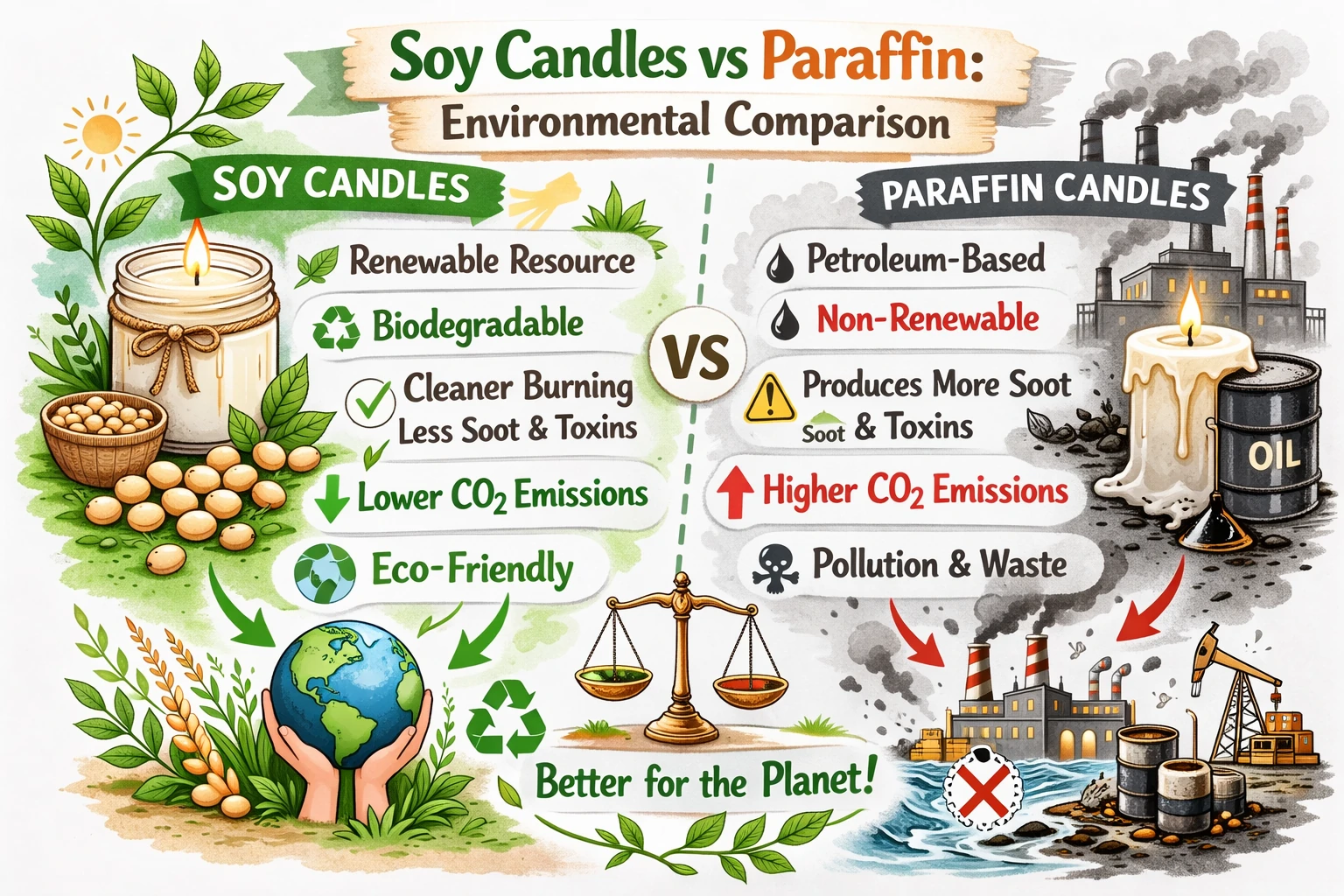
Paraffin wax is a petroleum-derived product. It is typically produced during the refining of crude oil into fuels and other petrochemicals. Because it comes from fossil resources, paraffin is not renewable on human timescales. The environmental impacts associated with paraffin begin upstream, with oil extraction and refining—activities linked to greenhouse gas emissions, habitat disruption, spill risk, and broader pollution concerns.
One argument you may hear is that paraffin wax can be considered “efficient” because it uses a byproduct of an existing refining process. While it’s true that paraffin can be produced within the petroleum value chain, the overall system is still fundamentally tied to fossil fuel extraction. If your sustainability goals include reducing reliance on fossil resources, paraffin typically runs counter to that goal, even if some of the wax is sourced as a secondary stream.
Where Soy Wax Comes From
Soy wax is made from soybean oil, which is hydrogenated to become solid at room temperature. Because soybeans can be replanted and harvested annually, soy wax is generally considered renewable. In principle, that gives soy an advantage in a world trying to shift away from fossil-based materials. However, renewability does not automatically equal low impact.
Soy agriculture can carry significant environmental issues depending on where and how soy is grown. These can include land-use change, deforestation in certain regions, loss of biodiversity, fertilizer runoff that affects waterways, soil degradation, and emissions from farming equipment and transport. The environmental profile of soy wax improves when soy is sourced from well-managed farms, regions with strong environmental regulation, and supply chains that prioritize responsible land use.
In other words: soy wax is renewable, but the sustainability of soy wax depends heavily on agricultural practices and sourcing transparency. If you’re evaluating “environmental comparison” seriously, soy is not a blank check—it’s a category that ranges from better to worse depending on the details.
Carbon Footprint: Fossil Carbon vs Biogenic Carbon
Both soy and paraffin release carbon dioxide when burned. The difference is where that carbon originates. Paraffin releases “fossil carbon,” meaning carbon that has been locked underground for millions of years and is newly introduced into the atmosphere when burned. Soy wax releases “biogenic carbon,” meaning carbon that was more recently captured from the atmosphere by plants during growth.
This distinction matters, but it is not the whole story. Biogenic carbon can be closer to “carbon-neutral” in theory, but only if the agricultural system does not create large emissions or land-use change. If soy cultivation leads to deforestation or heavy fertilizer use, those upstream emissions can significantly reduce the climate advantage. Conversely, if soy is grown in established agricultural areas using better practices, the overall footprint can compare favorably.
The most honest takeaway is that soy wax usually has a pathway to a lower carbon footprint than paraffin, but it depends on responsible sourcing. Paraffin’s carbon profile is more consistently tied to fossil emissions.
Air Quality and Burn Emissions in the Home
When people talk about “clean burning,” they often mix two different issues: wax chemistry and burn behavior. In practice, visible soot and indoor air impacts are strongly influenced by how a candle is wicked, how much fragrance load it contains, how long it is burned, and whether it is exposed to drafts. Any candle—soy or paraffin—can smoke if the wick is too large, the flame is flickering in airflow, or the candle is burned too long without trimming.
Paraffin candles are more often associated with soot complaints, especially in low-quality formulations or poorly wicked products. Soy wax blends can burn with less visible soot in many cases, but soy is not automatically soot-free. A “clean” candle is usually the result of good design: properly sized wicks, stable wax blends, quality fragrance oils, and user habits like keeping the wick trimmed and avoiding drafts.
If indoor air quality is your main concern, look beyond “soy vs paraffin” and pay attention to smoke behavior, wick type, and overall craftsmanship. Also consider using candles for shorter sessions, ventilating the room, and choosing products with transparent ingredient disclosure where possible.
Resource Use, Pollution, and Land Impacts
Paraffin’s resource use is dominated by fossil extraction and refining. The impacts are typically concentrated in oil-producing regions and along transport routes. Pollution risks include spills, refinery emissions, and the broader environmental costs associated with fossil fuel dependence. These impacts are substantial, though they can feel “invisible” to the end consumer because they occur far from the point of use.
Soy wax shifts the burden to agriculture. Land use becomes a major variable: how many acres are required, what ecosystems were replaced, and how the farming is managed. Fertilizer and pesticide use can create downstream effects such as eutrophication in waterways and harm to insect populations. Responsible agriculture can reduce these risks, but the range of outcomes is wide.
From a purely environmental perspective, soy can be the better option when it is sourced from lower-impact supply chains. But if soy is tied to destructive land conversion, the advantages can shrink dramatically. That’s why sourcing claims and certifications—while imperfect—matter more for soy than many people realize.
Biodegradability and End-of-Life Reality
Soy wax is often described as “biodegradable,” and compared with paraffin it generally breaks down more readily in the environment. Paraffin is more persistent because it is derived from petroleum. That said, biodegradability is not a license to treat any wax as harmless litter. Even biodegradable materials can cause environmental harm if they enter waterways or ecosystems in large amounts.
In real life, most candle waste is not the wax itself—it’s the container, packaging, shipping materials, labels, and leftover wax stuck to the vessel. A glass jar that is reused multiple times can reduce waste significantly compared with single-use containers. If environmental impact is your priority, reusability and packaging reduction are huge levers that often matter more than small differences between wax types.
Performance, Longevity, and “Per Hour” Footprint
Environmental impact is not just about what a candle is made from—it’s also about how long it lasts. A candle that burns longer per ounce can deliver the same enjoyment with fewer materials consumed. Soy wax is often associated with slower burn rates, especially in well-formulated candles, which can translate into a lower “per hour of burn” material footprint. However, performance varies widely by blend, wick choice, fragrance load, vessel size, and ambient conditions.
Paraffin can throw fragrance strongly, which some people interpret as “better” because they use the candle less time to scent a room. But strong throw can also come with increased soot risk if the design is poor. Soy can require more careful formulation for hot throw in some cases. There is no universal winner; the greenest candle is usually the one that is engineered well and used responsibly, not the one that relies on marketing labels.
The Fragrance Factor: A Hidden Environmental Variable
Many people focus entirely on wax and forget that fragrance oils can be a significant part of the candle’s chemistry and supply chain. Fragrances can be natural, synthetic, or blends, and their production can involve complex petrochemical processes or resource-intensive extraction. From an environmental standpoint, fragrance is often the least transparent component of a candle.
If you’re trying to reduce overall impact, consider candles with moderate fragrance loads, reputable ingredient transparency, and a focus on safe, stable burning. A candle that performs well with less fragrance oil is often a better choice than one that relies on high loads to compensate for weak formulation. This is not a call to avoid fragrance, but a reminder that “soy wax” alone doesn’t guarantee a low-impact product if everything else is excessive.
Sourcing, Certifications, and What to Look For
Environmental comparisons become much clearer when brands provide sourcing details. For soy candles, look for supply chains that emphasize responsible agriculture and reduced deforestation risk. Some producers highlight region of origin, farming standards, or traceability measures. While certifications can be imperfect and vary by country, they can be a helpful signal when paired with transparent reporting.
For paraffin candles, “environmental” improvements often come from refining quality, formulation, and burn design rather than from renewability. If you still choose paraffin for performance or cost reasons, prioritize well-made candles that burn cleanly, have stable wicks, and avoid excessive smoking. The goal is to reduce waste and reduce indoor pollution, even if the wax origin remains fossil-based.
Regardless of wax type, beware of vague claims. “Natural,” “eco,” and “non-toxic” are often used loosely in consumer marketing. Environmental responsibility is best supported by specifics: ingredient disclosure, burn testing practices, packaging choices, and transparent sourcing statements.
Packaging and Shipping: The Footprint You Can Actually Control
Two candles with identical wax can have very different footprints depending on packaging and transport. Heavy glass jars shipped long distances add emissions. Excess packaging adds waste. Individually boxed candles with multiple layers of plastic, foam, and glossy inserts may look premium but can be environmentally costly.
If your goal is to make a greener purchase, one of the simplest moves is to buy locally made candles when possible, or at least from brands that minimize packaging and use recyclable materials. Refillable systems or container-return programs can also make a big difference because they reduce the need to produce new vessels repeatedly.
Practical Habits That Reduce Impact (Any Candle)
The most sustainable candle is the one that is used efficiently. A few simple habits can cut soot, extend candle life, and reduce waste without changing your preferred wax type. Keep the wick trimmed to reduce smoking and improve burn stability. Burn long enough to create a full melt pool when appropriate, which can reduce tunneling and wasted wax. Keep candles away from drafts, fans, and open windows to prevent flickering and incomplete combustion.
When the candle is finished, clean and reuse the jar rather than discarding it. Reuse turns packaging into a durable household item and reduces the need for new containers. If you love candles as a lifestyle product, switching to jar reuse can be one of the most meaningful environmental changes you can make.
So Which Is Better for the Environment?
If you define “better” as renewable and potentially lower in fossil-carbon emissions, soy wax generally has the advantage. It comes from a plant-based resource and can align with a broader shift away from petroleum-derived materials. However, soy’s benefit depends on responsible agriculture and sourcing transparency. Poor land-use practices can erase much of soy’s environmental edge.
Paraffin wax is consistent in one key respect: it is fossil-derived. That typically makes it the weaker option for long-term sustainability goals. Still, a well-made paraffin candle that burns cleanly, is packaged responsibly, and is used efficiently can outperform a poorly made soy candle that smokes, tunnels, and gets discarded early. The quality of the product and the behavior of the user matter.
A realistic, environmentally-minded conclusion looks like this: choose soy when you can verify responsible sourcing, prioritize good burn design and moderate fragrance loads, reuse containers, and avoid wasteful packaging. If you choose paraffin, choose high-quality candles engineered to burn cleanly, keep them away from drafts, and reuse vessels to reduce the overall footprint.