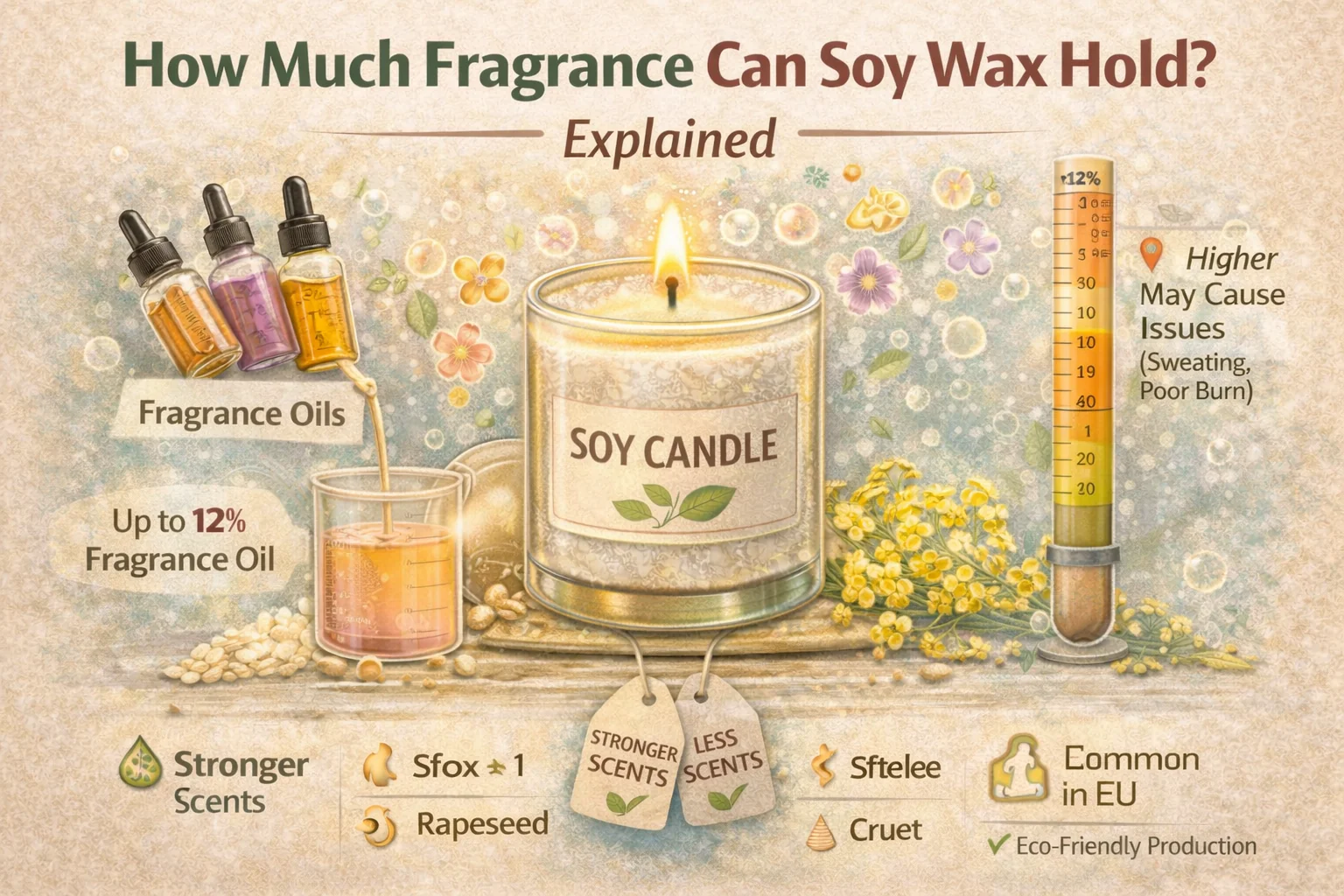
If you’ve ever made (or bought) a soy candle that smells amazing cold but barely throws scent when lit, you’ve already met the real question behind fragrance “load”: it’s not just how much fragrance oil you can add, but how much the wax can carry in a stable, burn-friendly way. Soy wax is loved for its creamy look and generally clean-burning reputation, but it has limits—chemical, physical, and practical—on how much fragrance it can hold before performance starts to drop. This guide explains what fragrance load means, what typical soy wax can handle, the warning signs of too much fragrance, and how to get stronger scent without pushing wax past its comfort zone.
What “Fragrance Load” Really Means
Fragrance load is the percentage of fragrance oil (or essential oil blend) added to wax by weight. It’s usually expressed as a percentage, such as 6%, 8%, or 10%. When people ask “How much fragrance can soy wax hold?”, they’re really asking how much oil can be dissolved and dispersed throughout the wax so it remains stable during cooling, curing, storage, and burning.
Wax holding capacity is partly about solubility: the wax must keep the fragrance evenly distributed without separating. But it’s also about combustion: too much liquid oil can change how the wick performs, how hot the melt pool gets, and how efficiently scent molecules evaporate into the air. So the “maximum” isn’t just a lab number—it’s the point before stability and burn quality start to suffer.
Typical Soy Wax Fragrance Capacity in Practice
Most common container soy waxes perform best in a moderate fragrance range. Many chandlers find that a middle zone—often around 6% to 9%—gives excellent results without stressing the wax. Some soy wax blends and specialized formulas can handle more, but higher loads don’t automatically mean stronger scent. In fact, once you cross the wax’s “sweet spot,” you may see weaker hot throw, sweating, or curing problems even though you used more oil.
The practical takeaway is simple: treat fragrance load as a tuning knob, not a volume knob. Strong scent is the result of a balanced system—wax type, fragrance type, wick choice, jar shape, pour temperature, and cure time—not a single big percentage.
Why Soy Wax Has Limits
Soy wax is a hydrogenated vegetable wax with a crystalline structure that changes as it cools. Fragrance oil is a complex mixture of aromatic compounds, many of which behave like lightweight liquids. When you add fragrance, you’re asking the solid wax structure to “trap” and hold those oils evenly. If you add too much, the structure can’t keep it all locked in place, and the candle becomes unstable.
Even when separation isn’t obvious, excess oil can migrate, collect near the surface, or create micro-pockets that interfere with consistent melting. That’s why two candles with the same fragrance percentage can perform totally differently depending on wax batch, room temperature, and how the candle was made.
The Difference Between Cold Throw and Hot Throw
Cold throw is the scent you smell when the candle is unlit. Hot throw is the scent that fills the room when the candle is burning. Increasing fragrance load often boosts cold throw quickly, which can trick you into thinking you’re improving the candle. But hot throw is more demanding: it depends on how well the fragrance vaporizes from the melt pool and how effectively the wick creates the right heat profile.
If the wick can’t create a stable, properly sized melt pool, the fragrance won’t evaporate efficiently. If the candle burns too cool, the wax won’t release scent strongly. If it burns too hot, the scent can degrade or smell “off.” That’s why “more oil” can sometimes make hot throw worse: it disrupts the burn and shifts the melt pool chemistry.
How Fragrance Type Changes the Maximum
Not all fragrances are equal in soy wax. Some fragrances are naturally strong, diffusive, and easy for soy to carry. Others are heavier, more resinous, or contain components that don’t bind as well in soy. A light citrus or airy floral may throw well at a lower load, while a complex bakery fragrance might need careful wicking and more cure time to reach its potential.
Some oils include ingredients that can be challenging for soy, especially if the blend is very thick or contains a high fraction of heavier aroma chemicals. In those cases, pushing to a very high percentage can increase the risk of sweating or uneven performance. The best approach is to test the same fragrance at multiple loads and keep everything else identical so you can see what the wax truly prefers.
What Happens When You Add Too Much Fragrance
Overloading fragrance doesn’t always look dramatic at first, but the candle will often tell on itself over time. If you want a reliable, good-burning candle, you should watch for several common symptoms. These don’t always mean the candle is “ruined,” but they strongly suggest the wax is being pushed beyond what it can comfortably hold.
You might see oily patches or “sweating” on the surface. The candle could feel softer than expected or develop a greasy top. You may notice tiny wet-looking spots, especially after temperature swings. Sometimes the candle’s surface will look slightly uneven or have faint “rivers” of oil as it sits.
Burn behavior can change too. A candle overloaded with fragrance can struggle to stay lit, mushroom excessively, produce more soot, or create a melt pool that becomes too deep too fast. It may also tunnel because the wick is not matched to the altered fuel mixture. Even if it burns, hot throw might become muted or inconsistent, especially after the first few burns.
The “Sweet Spot” Matters More Than the Maximum
When people chase the highest possible fragrance load, they often skip the more important target: the sweet spot where the candle is stable, safe, and strong. For many soy waxes, that sweet spot is where the wax holds fragrance evenly, the wick burns cleanly, and the melt pool reaches the right temperature for fragrance release. Moving beyond that zone can create diminishing returns or even reverse the benefit.
Think of fragrance load like seasoning in food. A little too low can taste bland. A little too high can overpower or ruin the balance. The perfect amount makes everything work together.
How to Calculate Fragrance Load Correctly
Fragrance load should be calculated by weight, not by volume. Measuring fragrance with spoons or “drops” makes results inconsistent because different oils have different densities. A digital scale is the most reliable way to repeat results.
If you want a 8% fragrance load, you multiply your wax weight by 0.08 to get the fragrance weight. For example, if you use 500 grams of wax, an 8% load would be 40 grams of fragrance. This method keeps your testing consistent so you can compare changes accurately.
What “Flash Point” Does (and Doesn’t) Tell You
Flash point is often printed on fragrance data sheets, and it causes a lot of confusion. It’s not a “safe pouring temperature” and it doesn’t automatically determine how strong the scent will be. It’s mainly a transport and handling classification metric. In candle making, the more practical issue is how heat affects evaporation and how well the fragrance binds with wax.
Instead of chasing flash point numbers, focus on consistent mixing, correct temperatures for your wax type, and enough cure time. Performance comes from good technique and proper testing rather than one label statistic.
Temperature and Mixing: The Hidden Keys to Holding More Scent
If you want soy wax to hold fragrance effectively, your mixing process matters as much as your percentage. Adding fragrance when wax is too cool can lead to poor binding and separation later. Adding fragrance when wax is extremely hot can risk driving off some of the lighter top notes before the candle even cools. The goal is thorough mixing at a temperature that encourages good incorporation without unnecessary volatilization.
Time matters too. Stirring for only a few seconds often isn’t enough. A longer, steady stir helps distribute fragrance evenly so the wax can cool as a uniform mixture instead of a wax-and-oil swirl that separates after the pour.
Cure Time: Why Scent Gets Better Later
Freshly poured soy candles can smell faint or “flat,” and that’s normal. Soy wax typically benefits from curing because the wax crystal network continues to settle and the fragrance becomes more integrated. Over days and weeks, cold throw often becomes more defined, and hot throw can improve as the candle burns more evenly.
If you test a soy candle too early, you may think you need more fragrance—when what you really need is patience. This is one reason beginners overload fragrance: they evaluate scent before the candle has finished stabilizing.
Wicking: The Fastest Way to Improve Hot Throw Without Overloading
A well-chosen wick is often the difference between “soft scent” and “room-filling throw.” The wick controls melt pool diameter and temperature, and those control fragrance release. If your wick is too small, the candle burns cool and tunnels, limiting evaporation. If your wick is too large, the candle can run hot, produce soot, and burn through fragrance too quickly.
When a candle’s hot throw is weak, many makers jump straight to increasing fragrance load. A smarter move is to evaluate whether the melt pool is reaching the right width and depth after a normal burn session. Often, a small wick adjustment boosts hot throw more than adding extra oil.
Container Shape and Wax Depth Affect Scent Release
The same wax and fragrance can behave differently in different jars. Wide containers create broader melt pools, which can increase evaporation area and improve hot throw. Tall, narrow containers may burn differently and can trap heat in a way that changes how the fragrance disperses.
Even fill level matters. A candle that is poured very deep may take longer to reach a stable burn pattern. When testing fragrance load, keep your jar type, wax amount, and wick consistent so you can isolate what’s really changing.
How to Test Fragrance Load Like a Pro
The best way to find how much fragrance your soy wax can hold is structured testing. Choose one wax, one fragrance, one jar, and one wick series. Make small test batches at different fragrance loads—such as a lower, mid, and higher level—while changing nothing else. Label each candle clearly with wax, wick, fragrance, percentage, pour date, and any process notes.
After curing, test burn each candle in the same type of room. Pay attention to melt pool size after a standard burn session, how stable the flame is, and how the scent develops over time. Also watch the candle after it cools: surface appearance, sweating, and any changes that happen days later are valuable clues.
Your goal isn’t to “win” the highest number. Your goal is to find the lowest fragrance load that delivers the hot throw you want while maintaining a clean, stable burn. That is the true performance zone.
Tips for Stronger Scent Without Increasing Fragrance Percentage
If you want a stronger candle, there are several improvements that often work better than adding more oil. First, make sure you’re using a fragrance that is known to perform in soy wax; some oils simply throw better than others. Second, refine your wick choice so the candle reaches a proper melt pool without overheating. Third, give soy candles enough cure time before judging performance.
You can also improve consistency by controlling your environment. Rapid temperature swings during cooling can affect the wax structure and potentially the way fragrance settles. Keeping candles in a stable room temperature during curing helps reduce surprises.
Finally, focus on repeatability. Strong scent is easier to achieve when every batch is made with the same method, measured by weight, and tested with notes. The “best” candle makers aren’t guessing— they’re collecting evidence and dialing in a formula.
So, How Much Fragrance Can Soy Wax Hold?
Soy wax can hold a meaningful amount of fragrance, but it performs best when you stay within a stable, burn-friendly range and treat the candle as a full system. Many soy container waxes deliver excellent results in a moderate percentage zone, and going higher often produces diminishing returns. The strongest candles usually come from balanced formulation: a compatible fragrance, thorough mixing, proper cure time, and a wick that creates the right melt pool.
If you’re aiming for premium performance, the real win is not pushing the maximum. The real win is finding the sweet spot where your candle smells rich, burns cleanly, and stays consistent from the first burn to the last.