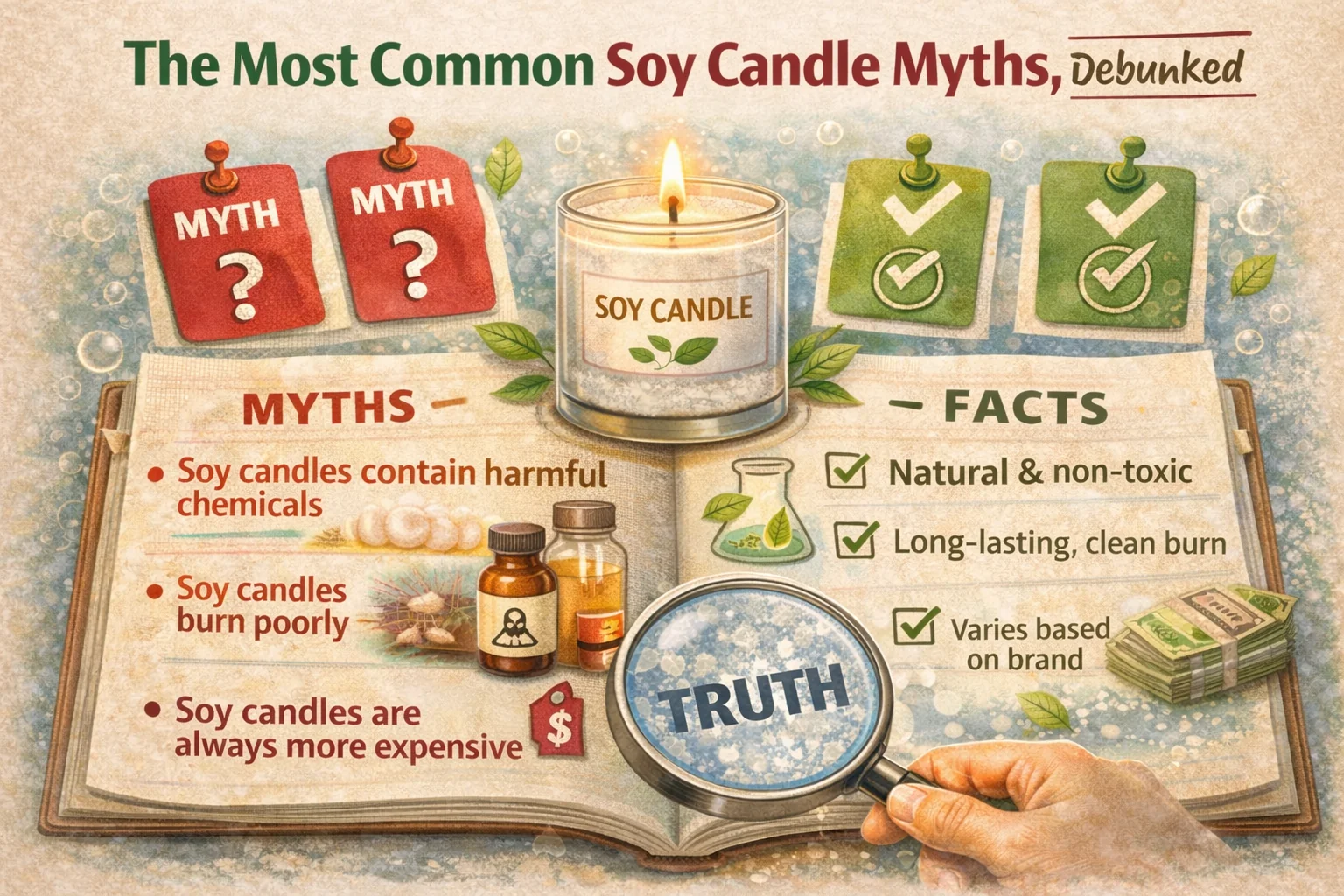
Soy candles have become a favorite for people who want a cozy home, pleasant fragrance, and a “cleaner-feeling” candle experience. But popularity always brings myths—some harmless, some misleading, and some that can cause people to buy the wrong product or use candles in unsafe ways. This article breaks down the most common soy candle myths and replaces them with what actually matters when you’re shopping, burning, or gifting.
The goal isn’t to make soy sound perfect or to criticize other waxes. It’s to help you separate marketing phrases from real-world performance, so you can pick candles based on quality, not hype.
Myth: “Soy candles are always non-toxic.”
This is one of the biggest misunderstandings. “Soy wax” describes the base wax, not the entire candle. A candle is a system: wax, wick, fragrance (or essential oils), dyes, and sometimes additives. Soy wax can be part of a well-made candle, but it doesn’t automatically make the candle non-toxic.
What matters more than the wax label is the quality and transparency of the full formula. Look for clear ingredient practices, reputable suppliers, and fragrance choices designed for candles. If you’re sensitive to strong scents, the most practical approach is to choose unscented or lightly scented candles regardless of wax type, and to burn with good ventilation.
Myth: “Soy candles produce zero soot.”
All flames produce some byproducts. A soy candle can produce less visible soot than some alternatives in many real-life conditions, but “zero soot” is unrealistic. Soot is influenced by more than wax type: wick size, wick material, fragrance load, airflow, burn time, and whether the wick is trimmed.
If you see smoke and dark residue, the candle might be tunneling, the wick may be too large, or the flame might be disturbed by drafts. A well-matched wick and proper burning habits often make a bigger difference than the wax label alone.
Myth: “Soy candles always burn longer.”
You’ll often hear that soy burns longer, and it can—especially when the candle is properly wicked and poured with a balanced formula. But burn time isn’t guaranteed. Two soy candles of the same size can behave very differently.
Burn time depends on jar diameter, wick choice, wax blend, fragrance percentage, and the way you burn it. If you burn a candle for very short sessions, you can cause tunneling and waste wax along the sides, which reduces usable burn time. A good soy candle can be slow-burning, but quality and use matter.
Myth: “If it’s labeled ‘soy,’ it must be 100% soy.”
“Soy candle” doesn’t always mean the wax is 100% soy. Some products use soy blends that include other waxes to improve hot throw, texture, color stability, or ease of manufacturing. Blends aren’t automatically bad. In fact, some blends are excellent—especially when they’re disclosed and designed for performance.
If you specifically want 100% soy, look for clear wording like “100% soy wax” and transparent product descriptions. If the label is vague, it may be a blend. When in doubt, choose brands that explain what they use and why.
Myth: “Essential oils are always safer than fragrance oils.”
This myth shows up across many scented products, and candles are no exception. Essential oils are natural extracts, but “natural” doesn’t automatically mean gentler or safer—especially when heated and diffused into the air. Some essential oils can be irritating, trigger headaches, or be unsuitable around pets in certain conditions.
Candle-safe fragrance oils are formulated for stability, performance, and predictable behavior in wax. A high-quality fragrance oil can be a better choice than a low-quality essential oil for a candle, and vice versa. The smarter question is: was the scent material designed and tested for candle use, and is the brand responsible about dosage and formulation?
Myth: “A stronger scent means a better candle.”
Strong scent is not the same as quality. A candle can smell extremely powerful because it contains a high fragrance load or because it’s using a scent profile that “punches” in the air. That doesn’t guarantee clean burning, good wick behavior, or a balanced experience.
A high-quality candle often aims for a smooth, even hot throw that fills a room without becoming harsh. If you’re evaluating a candle, pay attention to how it burns: stable flame, minimal smoke, even melt pool over time, and a scent that stays pleasant rather than sharp or overwhelming.
Myth: “Frosting means the candle is low quality or ‘spoiled.’”
Frosting is the white, crystal-like look that can appear on soy wax. It’s extremely common and usually cosmetic. Soy wax is a natural product with a crystalline structure, and temperature shifts can encourage that frosted appearance.
A frosted soy candle can still burn beautifully and smell great. Many makers actually accept frosting as normal and focus instead on performance. If you see frosting, it doesn’t automatically mean the candle is old, defective, or unsafe. The real quality indicators are burn behavior, wick performance, and scent balance.
Myth: “Soy candles don’t need wick trimming.”
Wick trimming matters for almost every candle type. A long or mushroomed wick can cause a bigger flame, extra smoke, and faster fuel consumption. It can also lead to sooting on the jar rim and a less pleasant burn.
Keeping the wick at a moderate length before lighting usually helps the flame stay steady and reduces smoke. If you want your candle to last and look clean, wick care is one of the simplest “quality upgrades” you can do at home.
Myth: “Tunneling means the candle is bad.”
Tunneling—when wax melts down the center and leaves wax stuck to the sides—can happen for different reasons. Sometimes it’s a manufacturing issue (wrong wick size for the jar). But sometimes it’s a use issue: burning for short periods that never allow the melt pool to reach the edges.
A candle can tunnel even if it’s well-made, especially during the first burn if it’s extinguished too quickly. The first few burns can shape the candle’s future behavior. Longer sessions early on often help create an even melt pool. If tunneling happens repeatedly under good burn habits, then the wick may not be well matched to the vessel.
Myth: “A perfectly smooth top proves it’s premium.”
Many people judge candles by appearance: glossy top, perfect color, flawless surface. But looks can be misleading. Some waxes naturally cool smoother than soy, and even soy can be poured to look very smooth depending on temperature and additives.
A candle that looks perfect can still burn poorly if the wick is wrong or the fragrance load is unbalanced. On the other hand, a candle with minor cosmetic quirks can burn wonderfully. Performance is the real test: consistent flame, clean jar walls, controlled melt pool, and reliable scent throw.
Myth: “Bigger wicks are always better for scent throw.”
It’s tempting to assume a bigger flame equals better scent. But oversized wicks can create too much heat, causing smoking, soot, fast burn, and potentially a harsh scent experience. A wick’s job is to feed the flame at the right rate—not the maximum rate.
Good scent throw usually comes from balanced formulation and correct wick sizing for the jar diameter. The best candles feel controlled, not chaotic: the flame is steady, the jar doesn’t overheat, and the scent blooms gradually rather than blasting the room instantly.
Myth: “Soy candles are ‘unscented’ if they smell like wax.”
Some soy wax has a mild natural aroma—sometimes described as a soft, neutral, or slightly “waxy” note. That doesn’t mean a candle is fragranced. Unscented candles can still have a natural base smell, especially when warmed.
If you’re very scent-sensitive, look for products explicitly labeled “unscented,” and consider testing in small spaces first. Also remember that the jar and wick can contribute subtle smells when heated, especially during the first burn.
Myth: “Soy candles are automatically eco-friendly.”
Soy wax is often marketed as eco-friendly because it comes from a renewable source. But sustainability depends on the full picture: sourcing, farming practices, supply chain, packaging, and whether the candle is designed to burn efficiently.
A “greener” candle often pairs thoughtful materials with responsible packaging and a long, efficient burn. Reusable jars, minimal excess packaging, and clear sourcing statements can be meaningful signs. Eco claims are strongest when brands explain what they do, not just what they say.
What to Focus on Instead of Myths
If you want to shop smarter, shift your attention from catchy claims to practical indicators of quality. Look for brands that describe their wax type clearly (soy or soy blend), mention wick material, and provide burn instructions that show they care about performance.
When you burn a candle, watch the flame and melt pool. A stable flame and controlled melt pool over time usually indicate good wick pairing. Minimal smoke, a clean jar rim, and a scent that fills the space comfortably are the real signs you chose well.
Most importantly, remember that candle performance is a combination of the product and the user. Even a great candle can behave poorly in a drafty spot or with an untrimmed wick. When you understand what’s myth and what’s mechanics, you’ll enjoy candles more—and waste less wax along the way.
Final Takeaway
Soy candles can be an excellent choice, but they aren’t magic. They don’t automatically become non-toxic, soot-free, or perfect just because “soy” is on the label. The best results come from a well-made candle, transparent sourcing and formulation, and good burning habits. Once you ignore the myths and focus on real-world indicators, buying soy candles becomes simpler—and a lot more satisfying.